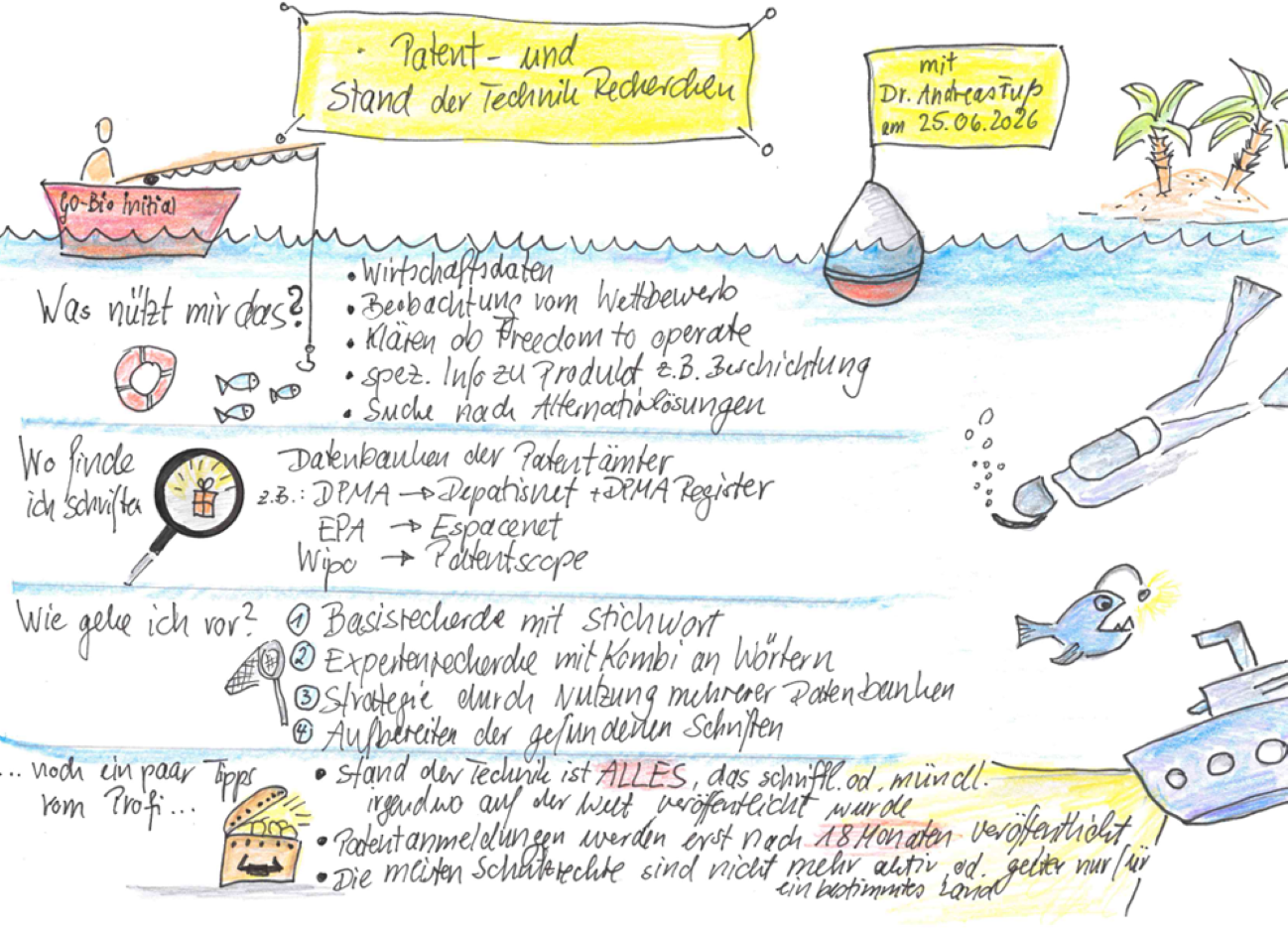
How do I find patent specifications and carry out a patent search myself? This was the focus of the second research workshop on 25 June 2026, led by Dr Andreas Fuß, a graduate chemist. The highly experienced researcher shared his wealth of knowledge with the participants of the GO-Bio initial event, enabling them to take part in the research process in real time.
Dr Fuß presented the various patent databases in which patent applications and granted patents can be searched free of charge. Using the German Patent and Trade Mark Office (DMPA) as an example, he first explained how to carry out a simple basic search in the Depatisnet database. Entering search terms was quickly explained, but the challenge lies in the various spellings and special characters used, which are very common in academic contexts. The participants were then introduced to the European Patent Office’s Espacenet database, before moving on to the US Patent and Trademark Office and the Japan Patent Office. Dr Fuß also patiently guided the participants through the specifics of the somewhat more demanding expert search and demonstrated how to download the documents found and process them further for their own use. He also highlighted the Patent Office’s translation function, which enables users to read and evaluate texts in foreign languages effectively.
He also highlighted the limitations of a search by pointing out that, by law, intellectual property rights cannot be found in the databases for a period of 18 months from the date of filing. This means that searches look back into the past and, at the earliest, will only find publications that were published 18 months ago. For start-ups, it is also very important to carry out ‘Freedom to Operate’ (FtO) searches. These involve additionally examining the legal status of the documents found, which reveals whether a property right is still active or has already expired. As Dr Fuß revealed, most documents have in fact already expired, were never granted, or are only valid in a specific country.