On October 21st, 2026, the next GO-Bio initial online event took place, focusing on the theme ‘Modern Prosthetics: The Development of Innovative Materials and AI’.
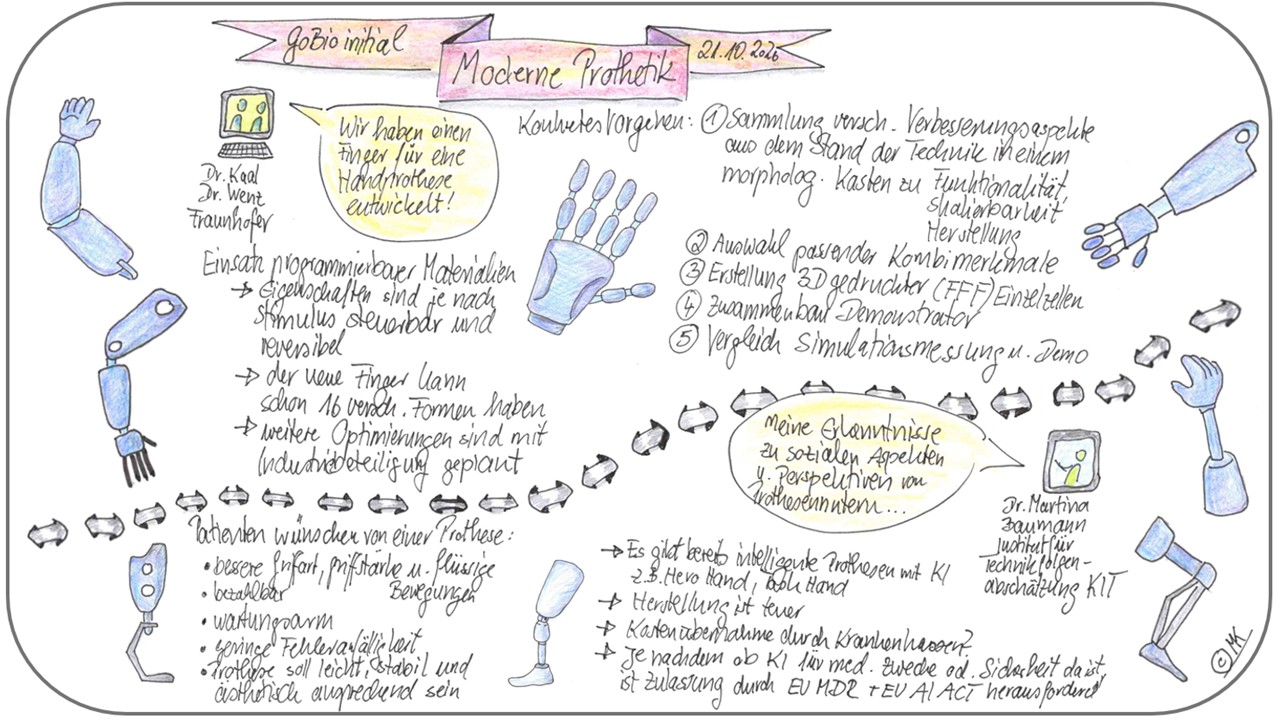
Dr Kaal from the Fraunhofer Society presented a joint project in which an improved finger for an aesthetic hand prosthesis was developed. He emphasised that the project primarily addressed, developed and implemented issues raised by industry, whilst also taking into account the perspectives and wishes of patients. The project began with the development of programmable materials whose properties can be controlled by specific stimuli. For the improved finger, several areas for improvement were taken into account, and the various implementation options were presented and evaluated in the form of a morphological matrix.The improvements were initially intended to focus on enhancing the functionality of the middle finger, a simple and cost-effective manufacturing process, and scalability – that is, the ability to adjust the size. His colleague, Dr Wenz, then gave a very clear account of the implementation process, starting with the 3D printing of bistable individual components, through to an initial prototype comprising several individual components, the simulations and measurements, and finally the creation of an improved finger that meets the desired requirements.
Dr Baumann from the Institute for Technology Assessment and Systems Analysis (ITAS) at KIT (Karlsruhe Institute of Technology) then highlighted ethical, legal and user-acceptance aspects relating to AI-assisted hand and leg prostheses, and reported on the insights she had gained during her doctoral research whilst engaging with various stakeholders, such as users, developers, health insurance providers and regulatory authorities regarding AI-assisted hand and leg prostheses. She emphasised how important it is to involve users in the product development of new prostheses and to take their requirements into account in order to increase acceptance. For example, the issue of sweating under the prosthesis remains unresolved. Dr Baumann also addressed the legal challenges relating to regulatory approval (EU MDR and EU AI Act) and the situation regarding reimbursement by health insurance. Finally, cost-benefit considerations and the risks arising from unauthorised or faulty actions by an AI-controlled prosthesis, along with the associated liability implications, were discussed.